Tuesday, 13 October 2026   


Never see Ash'ariyyah in the same light, ever again! Aristotle of Stageira, Philo of Alexandria, Augustine of Hippo, the Sabeans of Harraan, the Mu'tazilites of Basrah and Baghdad and the Jahmite Ash'ari Heretics of Today Claiming Orthodoxy. Read the first article, the second article, the third article, the fourth article, the fifth article.
You are here: Home Articles
Shaykh Abdul-Qadir al-Jeelaanee (d. 561H): Allaah is the Reckoner of Every Ash'ari Innovator, Strayer, Leading others Astray Who Claims Allaah's Speech is Meaning Only and Not Letter and Voice
Posted by Abu.Iyaad, in Articles
Topics: Abdul-Qadir Al-Jeelaanee • Kalaam Nafsee • Qur'an • Abdul-Qadir Al-Jilani

  Mail To Friend    Printer Friendly Bookmark and Share

Bayaan Talbees al-Jahmiyyah al-Ash'ariyyah

In previous articles we explained how the Jahmite Ash'aris believe in secret that the Qur'an we recite and memorize is just an "ibaarah (expression)" of the second Qur'an they believe in (which is just a meaning present with Allaah's Self), and that this ibaarah is created (but they forbid that this should be said openly) as is explicitly stated in al-Bayjuri's Haashiyah upon al-Jawharah (one of their standard and most famous textbooks). Then there was the saying of Fakhr ud-Din ar-Razi (d. 606H) that the As'haris and Mu'tazilah are actually agreed that the Qur'an we have is created, but they just differ on issues of wording and terminology (see here). Then there is the saying of the contemporary Ash'ari, Muhammad Sa'eed Ramadan al-Buti - and we brought his saying establishing the same (see this article). And likewise the saying of al-Juwaynee (d. 478H) confirming they are in agreement with the Mu'tazilah regarding the Qur'an being created (in this article), and then another article on another section in al-Bayjuri's Haashiyah confirming that the Qur'an that is recited (maqroo') is created (see this article).

All of this is based upon their doctrine of Kalaam Nafsee that they stole and plagiarized from the Kullaabiyyah and whose beginnings lay in the schemes and plots of the Jahmiyyah Lafdhiyyah in their saying that this Qur'an we have is only a "hikaayah" - see Ahmad bin Sinaan al-Waasitee (d. 258H), the Shaykh of al-Bukhaaree and Muslim speak about those zindeeqs in this article here, and see Ibn Battah (d. 387H) discuss the roots and origins of the Kullaabiyyah Ash'ariyyah in the doctrines of the conniving Jahmiyyah Lafdhiyyah in this article here.

We also brought a quote from the Mufassir, Ibn Jareer at-Tabari (d. 310) in which he cleaned out the rat-holes and secret hideouts of the Jahmites in a single sweep, cursing them, reviling them and making takfeer of them on account of their claiming the Qur'an (that we read, recite, memorize and hear) is created - may Allaah have mercy upon him. And all of the above, sent them fleeing on their heels, full of awe and terror, with their intellectual frauds and innermost secrets brought out into the open and pounded with fire and brimstones - with not a whisper or whimper in response.
In addition to that we brought the takfeer made by Shaykh Abdul-Qadir al-Jilaanee (d. 561H) of those who say that the Qur'an we have with us is merely a created "ibaarah" (expression). In fact he spoke with very severe words, which you can read in full in this article here (and you must take caution because there are lots of fireworks going off in every direction in that article!).

And in addition to that, we brought the saying of Shaykh Abdul-Qadir also that the Ash'arites who claim the Qur'an is an ibaarah (expression) or that their pronunciation of the Qur'an is created (as is taught in their standard textbooks), then Allaah has threatened them with the Fire, just as He threatened al-Waleed bin al-Mugheerah al-Makhzoomee - see this article here.

We want to now bring some more speech from Shaykh Abdul-Qadir al-Jeelaanee on the subject and it is something he says within the same section we quoted from previously in the book "al-Ghunyah".

Shaykh Abdul-Qadir: Allaah is the Reckoner of Every Ash'arite Mubtadi' (Innovator), Daall (Strayer), Mudill (Leading Others Astray), Who Claims Allaah's Speech is Meaning Only

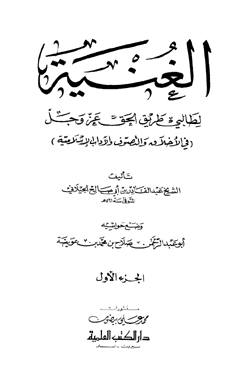
He says in "al-Ghunyah Li Taalibee Tareeq il-Haqq" (Daar ul-Kutub al-Ilmiyyah, Beirut, 1997, 1/130-131):

This translates:

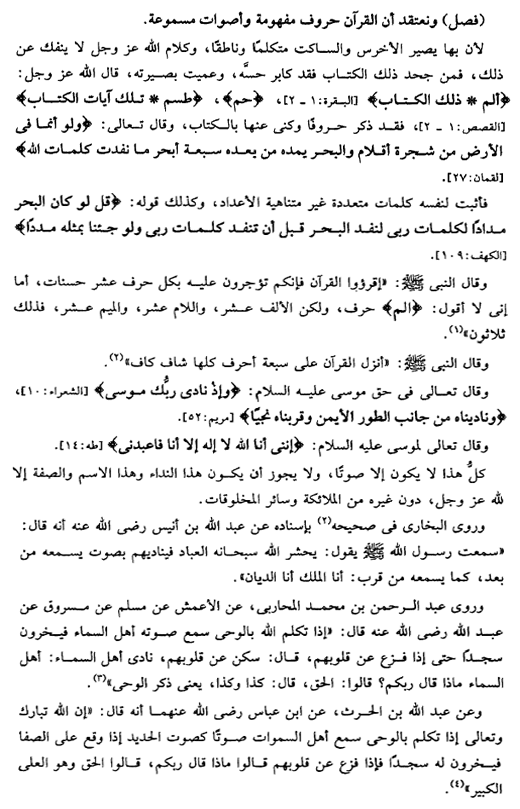
(Chapter): And We Believe that the Qur'an is letters understood and voices heard.

Because through them (letter and voice) does the dumb and silent become speaking (mutakallim), delivering speech (naatiq). And the speech (Kalaam) of Allaah does not depart from that. So whoever rejected "Dhaalik al-Kitaab" (as being letter and voice) then he has been arrogant in rejecting [what] his own perceptive faculty [informs him], and is blinded in vision (and insight).

Allaah the Mighty and Majestic said: "Alif Laam Meem. This is the Book (the Qur'an)" (Al-Baqarah 2:1-2), "Haa Meem.", "Taa Seen Meem. These are the verse of the Book." (al-Qasas 28:1-2). He has mentioned letters metonymically [using the name of one thing for another] for the Qur'an.

And the Most High said, "And if all the trees on the earth were pens and the sea (were ink wherewith to write), with seven seas behind it to add to its (supply), yet the Words of Allah would not be exhausted. Verily, Allah is All-ýMighty, AllýWise." (Luqman 31:27) So He affirmed numerous words for Himself that do not end in their number, and likewise His saying, "Say (O Muhammad). "If the sea were ink for (writing) the Words of my Lord, surely, the sea would be exhausted before the Words of my Lord would be finished, even if we brought (another sea) like it for its aid." (Al-Kahf 18:109).

And the Prophet (sallallaahu alayhi wasallam) said:

Read the Qur'an for you will be rewarded with ten good deeds for every letter. As for me, I do not say that "Aleef Laam Meem" is a letter, but "Alif" is ten (good deeds), "Laam" is ten (good deeds) and "Meem" is ten (good deeds), and that makes thirty.

And the Prophet (sallallaahu alayhi wasallam) said,

The Qur'an was revealed upon seven ahruf (letters, meaning variant readings), all of them are replete, sufficient.

And Allaah, the Most High, said regarding Moses (alayhis salaam), "And (remember) when your Lord called (naadaa) Moses..." (Ash-Shu'ara 26:10), "And We called him (naadaynaahu) from the right side of the Mount, and made him draw near to Us for a talk with him Moses (qarrabnaahu najiyyaa)." (Maryam 19:52). And Allaah, the Most High, said to Moses (alayhis salaam), "Verily! I am Allah! Laa ilaaha illaa Ana (none has the right to be worshipped but I), so worship Me..." (Ta-Ha 20:14).

All of this is not except as a voice, and it is not permitted that this calling out (nidaa) and this noun (I am "Allaah") and attribute (none has the right to be worshipped) be [for anyone] except Allaah, the Mighty and Majestic, as opposed to the others besides Him from the Angels and all other creatures.

And al-Bukhaaree reports in his Saheeh with his chain of narration to Abdullaah bin Anees (radiallaahu anhu) that he said:

I heard the Prophet (sallallaahu alayhi wasallam) saying: The servants will be [resurrected and] gathered together, and He will call them with a voice, the one who is distant will hear it just like the one who is near, [saying], "I am al-Malik, ad-Dayyaan."

And Abdur-Rahmaan bin Muhammad al-Muhaaribee reported from al-A'mash from Muslim, from Masrooq from Abdullaah (radiallaahu anhu), [that] he said:

When Allaah speaks with revelation, the inhabitants of the heavens hear His voice, and they fall prostrate until when the fear is removed from their hearts. He (Abdullaah) said: [When] it (the fear) subsides from their hearts, the inhabitants of the heaven say, 'O inhabitants of the heaven (i.e. the Angels), what did your Lord say?' They say, 'The Truth, He said such and such', meaning the revelation (that He spoke with)'.

And from Abdullaah bin al-Harth from Ibn Abbaas (radiallaahu anhumaa) that he said:

Indeed Allaah, the Blessed and Exalted, when He speaks with revelation, the inhabitants of the heavens hear a voice like the sound of iron when it falls upon the rock, so they fall prostrating to Him anda when the fear is removed from their hearts they say, 'What did your Lord say?' They reply, 'The truth, and He is al-Aliyy (the Most High), al-Kabeer (the Great).

After bringing these evidences he then says:

Which translates:

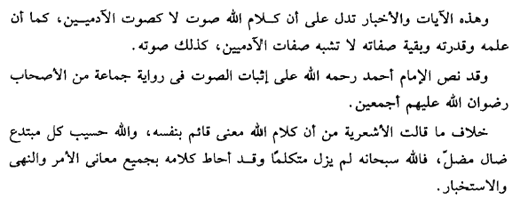
And these verses and narrations prove that the Speech (Kalaam) of Allaah is with a voice, not like the voices of men, just like His knowledge, power, and remaining attributes do not resemble the attributes of men, then likewise His voice. And Imaam Ahmad (rahimahullaa) has textually stated the affirmation of voice (sawt) in the narration of a group from his companions, may Allaah be pleased with them all, in opposition to what the Ash'arites said, that the Speech (Kalaam) of Allaah is just the meaning established with His Self, and Allaah is the reckoner of every Innovator (mubtadi'), misguided (daall), misguiding others mudill). For Allaah, the Sublime, has never ceased to be mutakallim (one who speaks), and His Speech (Kalaam) comprises all of the meanings of command (amr), prohibition (nahy) and al-istikhbaar (inquiry).

What has been explained here is the view of the entirety of the Salaf and it is what all the Imaams are upon, including Imaam Ahmad and Imaam al-Bukhaaree, that Allaah speaks when and as He wills, with letter and voice.

As for their doubt that a voice requires lips, mouth, throat, larynx and so on - then that doubt which originated with the Jahmiyyah (as explained and refuted by Imaam Ahmad in "ar-Radd alal-Jahmiyyah") - and which was followed by the Ash'arites when they appeared on the scene a couple of hundred years after, then that has been responded to in this article (refer to point no. 5). And in any case, upon that line of reasoning, the Ash'arites would have to reject, hearing and seeing, for there is nothing in the creation described with these two attributes except that it requires organs for these faculties to exist.

As for the issue of whether the letters (huroof) are created or not, then the viewpoint of Ahl us-Sunnah is that clarified by Imaam Ahmad which is that we do not say they are created absolutely and nor uncreated absolutely. For when Allaah speaks (with letter and voice) then they are not created, and when mankind speaks, then what they speak is created. And this is because Allaah from His eternal knowledge, knows all of the languages of mankind, and as He is one who speaks with whatever He wills, whenever He wills, however He wills, then He is able to speak to them with His revelations in the language that they know and understand, thus the Torah was revealed in Hebrew, and Allaah spoke to Moses direct in the language that Moses knew, and likewise with the Injeel (Aramaic) and likewise with the Qur'an (Arabic) and in all of that Allaah's speech is uncreated, and all of this is from Allaah's complete perfection and His perfect knowledge, and likewise Allaah will speak on the Day of Judgement to each person when He holds them to account, without there being any translator between them. So, we do not say either saying absolutely - and this can be covered in more detail in a separate article.

As for the saying of the Jahmiyyah, Kullaabiyyah Ash'ariyyah that letters imply succession and so on, all of that is based upon their creed of negating "hawaadith" from Allaah, which is in turn based upon their intellectual proof of "hudooth ul-ajsaam" in which they simply borrowed the language and terminology of the atheist Philosophers themselves.

Ibn Suraij as-Shafi'ee (d. 306H) said, as narrated from him by Abu Ismaa'eel al-Harawi in "Dhamm ul-Kalaam" and as mentioned by Ibn Taymiyyah in "Bayaan Talbees al-Jahmiyyah":

توحيد اهل العلم وجماعة المسلمين أشهد أن لا اله الا الله وان محمدا رسول الله وتوحيد اهل الباطل الخوض في الأعراض والأجسام وانما بعث النبي صلى الله عليه وسلم بانكار ذلك

The Tawheed of the people of knowledge and the jamaa'ah of the Muslims is "I testify none is worthy of worship except Allaah (alone) and that Muhammad is the Messenger of Allaah". And the Tawheed of the people of falsehood is disputing about al-a'raad (incidental attributes) and al-ajsaam (bodies) and the Prophet (sallallaahu alayhi wasallam) was sent with the rejection of that.

And this is what their entire deen is based upon. So when they bring these rational, intellectual objections, you should know the their true and real origins. These people do not treat the revealed texts (i.e. Allaah's speech) to be decisive and definitive. They consider their intellectual proof of demonstrating the universe is created (hudooth ul-ajsaam) to be the ultimate truth around which all truth, and revealed texts, revolve, and upon which they are evaluated.

And the deen of the Ash'arites in particularly, stolen and plagiarized from the deen of the Kullaabiyyah is to reject that Allaah has actions tied to His will and power - and this is the basis of their rejection of the attributes that they reject. The earlier Kullaabi ones amongst them nevertheless affirmed Allaah's uluww (with His Essence) and also affirmed the attributes of Face, Hands, Eyes, as sifaat dhaatiyyah without ta'weel, tahreef, or tafweed, and in these issues they had refutations against the Jahmiyyah and Mu'tazilah (following the Kullaabiyyah) in that. As for the later Ash'arites they simply reverted back to the doctrines of the Jahmites and Mu'tazilah in these and numerous other issues.


Link to this article:   Show: HTML Link • Full Link • Short Link
Share or Bookmark this page: You will need to have an account with the selected service in order to post links or bookmark this page.


Subscribe via RSS or email:
Follow us through RSS or email. Click the RSS icon to subscribe to our feed.


Related Articles:
Add a Comment
You must be registered and logged in to comment.


Don't Be Deceived By the Terminology of the Jahmiyyah!
(Introduction) (al-jism) (al-'arad) (Hulul al-hawaadith) (al-tarkib
)

Series View More...

Topics
Basics
Scholars
History
Misconceptions
Ibn Taymiyyah
Articles
Sunni Answers
Audio
The Clinic

Latest Articles
The Jahmites and the Hadith Mentioning 'Harwalah' (Allah's Haste in Reciprocating and Rewarding His Servant)
The History and Origins of the Kalam Theology of the Asharis and Maturidis
Revelation, Philosophy and Kalam: The Creed of the Salaf Versus the Creed of the Asharis and Maturidis
The Creed of the Kullabi Asharis Preview: Part 11 - Concerning the Affirmation and Negation of Al-Hadd and the Doubts of the Jahmites
The Divine Attributes: The Righteous Salaf vs the Heretical Kalam Schools - Part 2: Which Door Did the Ash'aris and Maturidis Come Through?
The Divine Attributes: The Righteous Salaf vs the Heretical Kalam Schools - Part 1: Introduction
The Saying of the Salaf (منه بدأ وإليه يعود), Imaam Al-Tahawi's Uncreated Single Qur'an and Sa'eed Foudah's Two Qur'an Doctrine: Part 3
The Saying of the Salaf (منه بدأ وإليه يعود), Imaam Al-Tahawi's Uncreated Single Qur'an and Sa'eed Foudah's Two Qur'an Doctrine: Part 2
The Saying of the Salaf (منه بدأ وإليه يعود), Imaam Al-Tahawi's Uncreated Single Qur'an and Sa'eed Foudah's Two Qur'an Doctrine: Part 1
Another Dishonest and Resentful Jahmite (Nizar Hammadi) Trying to Malign Ibn Taymiyyah: Regarding Fakhr Al-Din Al-Razi's Confusion

Pages
No pages found.

Most Popular
Destroying the Slander of Tajsim (Anthropomorphism) Against Ahl al-Sunnah wal-Jamaa'ah: Part 1 - Developing The Framework
Ibn Taymiyyah Compared With the Philosophers: Exposing Abu Adam al-Naruiji's Academic Fraud - Part 5: Ahl al-Sunnah, the Philosophers and Ahl al-Kalaam on Allaah's Actions and Origins of the Universe - Continued...
Aristotle of Stageira, Philo of Alexandria, Augustine of Hippo, the Sabeans of Harraan, the Mu'tazilites of Basrah and Baghdad and the Jahmite Ash'ari Heretics of Today Claiming Orthodoxy- Part 1
A Brief Biography of Abu Hasan a-Ash'ari And The Various Stages Of His Life In Relation To His Creed
Abu Hamid al-Ghazali (Imaam of the Later Ash'aris): If the Prophet Invited to Belief in Allaah Through the Language and Terminology of the Ash'arites, Not even One in a Thousand Would Accept It! Rather the Majority Would Tend to Atheism!
Ibn Taymiyyah Compared With the Philosophers: Exposing Abu Adam al-Naruiji's Academic Fraud - Part 4: Ahl al-Sunnah, the Philosophers and Ahl al-Kalaam on Allaah's Actions and Origins of the Universe
The American Chestnut Tree, The Willow Tree, Jahm Bin Safwan, The Mu'tazilah, Ibn Kullaab and the Early and Later Ash'aris - An Illustration
Why Ibn Sina, You Exceedingly Shrewd Kafir! Thank You For Supporting Our Aristotelian Metaphysical Creed and Backing Us (Ash'aris) In Our Saying That 'Allaah Is Not Within the Creation Nor Outside Of It'
Destroying the Slander of Tajsim (Anthropomorphism) Against Ahl al-Sunnah wal-Jamaa'ah: Part 9 - The Accusation of Tajsim and Tashbih Against al-Qadi Abu Ya'laa al-Hanbali
The Debates of al-Jahm bin Safwan (Summary Execution 128H) With the Indian Materialist Philosophers And the Origins of Ta'teel Within the Ummah

Archives (View more)
2020 • January
2018 • January
2017 • December
2014 • December
2013 • November
2013 • October
2013 • September
2013 • August
2013 • July
2013 • June
2011 • October
2011 • September


Key Topics
'arad • 21st century kalam atomist • a'raad • abdul-qadir al-jeelaanee • abdul-qadir al-jilani • abdullaah ibn al-mubaarak • abdullah ali al-amin • abu abdullah bin hamid • abu adam al-naruiji • abu adam naruiji • abu adam naruji • abu al-abbas al-qalanisi • abu al-hasan bin al-zaghuni • abu al-hudhayl al-allaaf • abu ali al-ahwazi • abu bakr al-baqillani • abu bakr al-isma'ili • abu bakr al-ismaa'eelee • abu bilal maliki • abu fadl al-tamimi • abu hamid al-ghazali • abu hanifah • abu hasan al-ash'ari • abu isma'il al-harawi • abu layth bin ataa • abu mansur al-baghdadi • abu ya'laa • abul-hasan ibn mahdi at-tabari • accident • adh-dhahabee • adh-dhahabi • af'aal ikhtiyaariyyah • ahl al-kalaam • ahl al-kalam • ahmad bin sinan al-waasitee • ahmed cobra • akhbaar ul-aahaad • al-'arad • al-aamidee • al-akhtal • al-amidi • al-arsh • al-ash'aree • al-ash'ari • al-ashari • al-baqillani • al-bayhaqi • al-bukhaaree • al-dhahabi • al-ghazali • al-hadd • al-hawaadith • al-ibanah • al-istiwaa • al-jahm bin safwan • al-jawhar al-fard • al-jihah • al-jism • al-juwaynee • al-juwayni • al-kawtharee • al-khateeb al-baghdaadee • al-khatib al-baghdadi • al-milal wan-nihal • al-muhasibi • al-naruiji • al-nawawee • al-nawawi • al-qadi abd al-wahhab al-maliki • al-qadi abu ya'laa • al-qalanisi • al-qurtubee • al-qurtubi • al-qushayri • al-razi • al-shahrastani • al-tabyin • al-taftazani • al-tahawi • al-tarkib • al-uluww • al-uluwww • al-wajh • al-yad • allaah's anger • allaah's names • allaah's pleasure • an-nadhr al-istidlaal • an-nawawi • anthropomorphism • anthropomorphists • ar-razi • aristotelian metaphysics • aristotelians anonymous • aristotle • arsh • as-sanusi • asaas ut-taqdis • ash'arees • ash'ari • ash'ari burnout • ash'ari scholars • ash'arite • ash'arites • ash'ariyyah • asharees • ashari scholars • asharis • asmaa • asrar rasheed • asrar rashid • at-tabari • at-tirmidhee • atabek shukrov nasafi • atheism • atomism • augustine • aydin • baqillani • barelwi • bayaan talbees al-jahmiyyah • bayjoori • bayjuri • belief science • better ash'ari • bi dhatihi • bishr al-mareesi • bucket theology • competition corner • composite • day of arafah • democritus • detox • divisible • early ash'aris • early asharis • eesaa • encompassment • fake hanbalis • fakhr al-din al-razi • fakhr ud-din ar-razi • falaasifah • falsafah • faqir • fawqiyyah • forty hadith • gf haddad • ghadab • grave worship • greek philosophers • haadith • haashiyah • hanbalis • harf • harran • harwalah • hellenism • hishaamiyyah • hizb ut-tahrir • hudooth • hudooth ul-ajsaam • hulool • hulul al-hawadith • ibn abi zayd al-qayrawani • ibn al-mutahhir • ibn asaakir • ibn asakir • ibn battah • ibn darbas • ibn fawrak • ibn hajr • ibn hajr al-asqalani • ibn jareer at-tabari • ibn jarir al-tabari • ibn khuzaymah • ibn kullaab • ibn kullab • ibn mahdi al-tabari • ibn seena • ibn sina • ibn taymiyyah • ibrahim osi-efa • idol worship • ihaatah • ilm al-kalaam • ilm al-kalam • ilm ul-kalam • imaam adh-dhahabi • imaam ahmad • imaam ahmad bin hanbal • imaam ash-shaafi'ee • imam malik • inqisaam • intercession • intoxication • istidlaal • istiwaa • ithbaat • ittihaad • ityaan • jahm bin safwaan • jahm bin safwan • jahmee baleed • jahmeespeak • jahmi baleed • jahmite • jahmite ash'aris • jahmites • jahmiyyah • jahmiyyah mu'tazilah • jawhar • jawharah • jawharat ut-tawhid • jihah • jism • jismiyyah • kalaam • kalaam nafsee • kalaam nafsi • kalam atomism • kalam nafsi • karraamiyyah • khabar ul-waahid • kullaabi ash'aris • kullaabiyyah • kullabi asharis • lafdhiyyah • later ash'aris • liquor • marifah • metaphysics • micro madrasa • mu'tazilah • muhammad abduh • muhammad anwar shah al-kashmiri • muhammad fahmi • muhammad sa'eed ramadan al-buti • muhdath • mujassimah • murakkab • mushabbihah • mutafalsifah • mutakallimoon • nadhr • naqd al-tadmuriyyah • naruiji • naseehah dhahabiyyah • neo-hanbalis • neo-platonism • nihaayat ul-iqdaam • nizar hammadi • nuh ha mim keller • nuh keller • nur uz zamaan institute • nuzool • personal development • philadelphian jahmite ash'aris • philadelphian jahmites • philo • philosophers • plato • pseudo-hanbalis • qadi abdul-jabbar • qu'ran • qur'an • qur'an creationists • quraan • quran • ridhaa • riyadh al-saaliheen • rizqullah al-tamimi • saalimiyyah • sabeans • saeed foudah • saeed foudah sa'id foudah • saint worship • salafiyyah • sawt • sayyid qutb • seeking ilm • self awareness • self help • shafaa'ah • shahrastaani • shahrastani • sifaat • sifaat dhaatiyyah • sifaat fi'liyyah • sifat fi'liyyah • sifat khabariyyah • substance • sumaniyyah • ta'teel • ta'weel • ta'wil • tabyin kadhib al-muftari • tafweed • taj al-din al-subki • tajseem • tajsim • takaafu' al-adillah • takyeef • tamtheel • taqi ad-din an-nabahani • taqiuddin al-nabhani • tarkeeb • tashbeeh • tawhid • tawhid al-ibaadah • tawhid al-ibadah • tawhid al-uloohiyyah • tawhid al-uluhiyyah • the clinic • the quran • the throne • theologians • thomas aquinas • throne • top tips • uluww • undercover ash'aris • voice • wahhabi • wahhabis • yahyaa bin ammaar • yusuf al-qaradawi • yusuf an-nabahani •
Copyright © 2026 . All rights reserved. RSS • Tags • Privacy • Legal and Terms of Use • Sitemap